by Brian Hammond (VP of Sales, FYC Labs)
You’ve heard it. Maybe this week.
“We’re not really an AI company.”
“Sounds expensive.”
“Isn’t that just ChatGPT?”
Your client isn’t wrong to be skeptical. They’ve been pitched AI by every SaaS vendor with a marketing budget since 2023. Most of those pitches were vague, buzzy, and disconnected from anything resembling their actual workday.
So when you bring up AI, you’re fighting through a wall of noise they didn’t build. You just have to walk through it.
The good news: skepticism about AI isn’t a closed door. It’s a sign that nobody’s bothered to make it concrete for them yet. That’s where you come in.
Here’s a 5-step framework you can use in your next client conversation. No slides required. No technical background needed. Just a few good questions and a willingness to listen for the right signals.
Step 1: Start With the Task, Not the Technology
The fastest way to lose a skeptical client is to lead with AI. Lead with their pain instead.
One question does most of the work here:
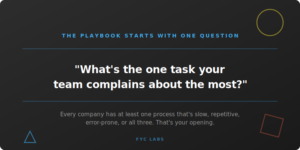
“What’s the one task your team complains about the most?”
That’s it. You’re not selling AI yet. You’re doing discovery. Every company has at least one process that’s slow, repetitive, error-prone, or all three. Data entry. Invoice matching. Sorting through intake forms. Pulling numbers from 4 systems into 1 report every Monday morning.
When they answer, you’ll hear the frustration in their voice. That frustration is your opening.
A few variations that work just as well:
- “If you could eliminate one bottleneck tomorrow, what would it be?”
- “Where do your best people spend time on work that doesn’t need them?”
- “What breaks first when your team gets busy?”
You’re listening for tasks that are repetitive, rule-based, and high-volume. Those are the ones AI chews through.
Step 2: Name the Cost of Doing Nothing
Skeptical clients aren’t weighing “AI vs. no AI.” They’re weighing “spend money on something I don’t fully understand vs. keep doing what we’re doing.” The status quo feels safe because nobody gets fired for leaving things the way they are.
Your job is to make the status quo feel expensive.
Once they’ve named the painful task, put a number on it. You don’t need to be precise. Rough math is more persuasive than no math.
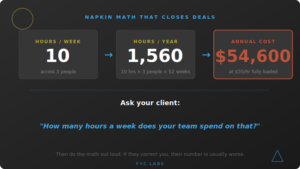
“How many hours a week does your team spend on that?”
Then do the arithmetic out loud. 10 hours a week across 3 people is 1,560 hours a year. At $35/hour fully loaded, that’s $54,600 spent on work that a well-built system could handle in minutes. Every year. Compounding.
You’re not quoting an AI project. You’re showing them what they’re already paying for the privilege of staying manual.
If they push back on the numbers, let them correct you. Their version is usually worse than yours.
Step 3: Show One Example (Preferably Boring)
The best AI pitch isn’t impressive. It’s relatable.
Skip the generative art demos. Skip the chatbot that writes poetry. Show them something that looks like their Tuesday afternoon.
“We built a tool for a [similar company] that reads incoming PDF invoices, pulls out the line items, and drops them into their accounting system. Their AP team used to spend 6 hours a day on that. Now it takes 20 minutes of review.”
The example should be:
- From a company they’d recognize as similar to theirs. Same size, same industry, same level of technical sophistication. If you’re talking to a 40-person landscaping company, don’t show them what a fintech startup built.
- Mundane enough to be believable. Flashy demos create distance. Boring demos create trust. The client should think “oh, we have that exact problem.”
- Specific enough to stick. Hours saved. Steps eliminated. Errors reduced. Give them a number they can repeat to their business partner over lunch.
If you don’t have a perfect case study, that’s fine. Describe the pattern: “Companies your size usually see the biggest wins when they automate [the thing they just told you about in Step 1].”
Step 4: Frame It as a Pilot, Not a Commitment
The word “implementation” makes skeptical clients tense up. It sounds like a 6-month project with a committee and a Gantt chart.
Instead, frame the first step as small and reversible.
“What if we just tested this on one process? Pick the one that annoys your team the most, build a focused proof-of-concept, and measure the result. If it works, we expand. If it doesn’t, you’ve lost a few weeks, not a few quarters.”
This does two things. It lowers the perceived risk to almost nothing. And it gives the client an easy “yes” that doesn’t require board approval or a 6-figure budget.
A few phrases that land well here:
- “We’re talking about a 4-6 week pilot, not a platform migration.”
- “You’ll know within a month if this moves the needle.”
- “The goal is to prove it works on your data, with your team, before we talk about anything bigger.”
The pilot approach also filters out bad-fit clients early. If someone won’t commit to a small test, they weren’t going to commit to anything. Better to know now.
Step 5: Give Them the Language to Sell It Internally
Here’s where most AI conversations stall: your client is convinced, but their business partner (or board, or ops lead) isn’t in the room. And your client doesn’t know how to explain what you just explained.
So give them the words.
“When you bring this up with [their decision-maker], here’s how I’d frame it: we found a process that’s costing us $50K+ a year in labor. There’s a way to test whether we can automate 80% of it in 4 weeks for a fraction of that cost. Worst case, we learn something. Best case, we free up the team for work that actually grows the business.”
You’re building them a script. Short, specific, tied to money. No jargon. No acronyms. Nothing that requires a technical explanation.
The best version of this is when the client says it back to you in their own words. That means it stuck.
The Objection Cheat Sheet
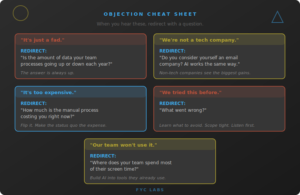
When you hear these, here’s how to redirect:
“It’s just a fad.” Ask them: “Is the amount of data your team processes going up or down each year?” The answer is always up. AI is how companies keep pace with growing data without growing headcount at the same rate. The trend line is the argument.
“We’re not a tech company.” Good. That means you’ll see a bigger impact. Tech companies have already optimized their operations. Companies that haven’t are sitting on the largest gains. Ask: “Do you consider yourself an email company? You use email every day. AI works the same way, it’s a tool for the work you already do.”
“It’s too expensive.” Flip it: “How much is the manual process costing you right now?” Then revisit the math from Step 2. The real question isn’t whether AI is expensive. It’s whether doing nothing is more expensive. (It usually is.)
“We tried something like this before and it didn’t work.” This is actually the most useful objection. Ask: “What went wrong?” You’ll learn exactly what to avoid. Usually the answer is that the previous project was too broad, too vague, or built by someone who didn’t understand their business. That’s precisely why a focused pilot with a team that listens matters.
“Our team won’t use it.” Fair concern. The fix is building the AI into tools the team already uses, not asking them to learn a new system. Ask: “Where does your team spend most of their screen time?” That’s where the AI should live.
The 60-Second Version
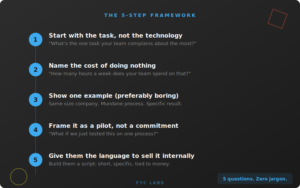
If you forget everything else, remember this sequence:
- Ask what task their team hates.
- Put a dollar amount on that pain.
- Show a boring, relatable example.
- Propose a small, low-risk test.
- Hand them the words to pitch it internally.
That’s the whole playbook. Five questions, five conversations, zero jargon.
Your client doesn’t need to believe in AI. They need to believe that the thing eating 10 hours of their team’s week can be fixed. You’re the person who shows them how.
FYC Labs builds custom AI solutions for companies that are ready to stop doing things the hard way. If your client has a process worth automating, let’s talk.